
Exchange rate 1USD = 44.69 UAH; 1EUR = 51.29 UAH
Login
/
Register

Steel Hydrocyclones (Sand Separators) (10)

Plastic hydrocyclones (4)
Hydro centrifugal filtration systems (6)
Hydrocyclones: Effective Purification for Various Sectors
Hydrocyclones: Efficiently Clean Water/Liquid from Suspended Solids Larger than 100 µm with a Specific Gravity Greater than 1 (Heavier Than Water/Liquid).
When searching for effective equipment for liquid purification, hydrocyclones are a reliable solution. We offer a wide range of hydrocyclones at affordable prices, ready to tackle tasks in agriculture, industrial enterprises, and the municipal sector.
Reliable Purification
Our hydrocyclones are designed to ensure effective purification of liquids/water. They securely capture particles and contaminants, ensuring cleanliness and quality of production in various sectors.
Application Areas
Hydrocyclones are ideal for purifying water from large-dispersion impurities. They provide clean water at enterprises where the cleanliness of work processes is crucial. On industrial premises, they handle tasks related to the purification of essential production environments.
Delivery Across Ukraine
We provide delivery of hydrocyclones across Ukraine, including major cities such as Kharkiv, Kyiv, Lviv, Dnipro, and Poltava. This is the perfect solution to ensure reliable purification in your field of activity.
Order hydrocyclones from us, and you will receive reliable equipment capable of efficiently purifying liquids/water. Contact us today to learn more about our hydrocyclones and start caring for the quality of your equipment.
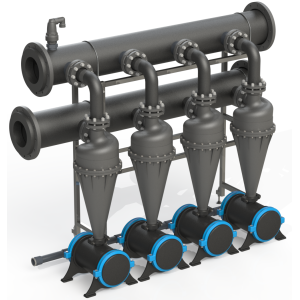
Hydrocyclone (desander) is equipment used in water treatment to purify water or liquid from insoluble coarse (coarse-dispersed) impurities in water or liquid. Water purification in a hydrocyclone is based on centrifugal force and allows for the removal of suspended solids (solid mechanical inclusions) with a specific gravity greater than 1 (heavier than water) and a filtration rating of more than 100 µm: stones, shells, sand, slag, rust, metal shavings, and the like.
Solid substances in a solid state that are present in water, having a natural origin, negatively affect water quality and can also be determined by the parameter of turbidity. Turbidity increases in open sources as a result of washing away solid particles (clay, sand, mud) from the upper soil layer by rain or meltwater during seasonal floods, as well as due to erosion of riverbeds. The highest turbidity occurs in spring during floods and in summer during rains, the melting of mountain glaciers, and the development of tiny living organisms and algae floating in water; the lowest turbidity is observed in winter.
Suspended solids have different particle size distributions, characterized by hydraulic coarseness. At a temperature of 10°C in stagnant water, it is expressed as the settling velocity of particles.
The table below shows the settling time of various (conditional) natural impurities depending on hydraulic coarseness:
Thus, in order to select a hydrocyclone, a preliminary analysis of water for particle size, their origin, and the quality of the influent water is necessary. The height, diameter, and rotational speed of the hydrocyclone will be selected based on these parameters. For example, with a smaller hydrocyclone diameter, it will generate more centrifugal force, and the size of the equipment depends on the density and weight of the pollutant particles.